
Criminal Personality & Thinking Patterns: A Clinical Perspective
Understanding behavior begins with understanding the stories people tell themselves.

Criminal personality is not simply the result of impulse, malice, or lack of morality.
It is a psychological architecture—a system of internal narratives, cognitive distortions, emotional dynamics, and learned behaviors that reinforce a sense of power, control, or survival.
Research in forensic psychology, criminology, and language analysis shows that individuals with entrenched antisocial or criminal patterns operate through repetitive narratives that justify harmful behavior while protecting a fragile internal identity.
Understanding these patterns is essential when working clinically with individuals who present:
- Persistent antisocial behaviors
- Severe cognitive distortions
- Manipulative interpersonal styles
- Difficulty assuming responsibility
- Emotional detachment or moral disengagement
This article explores how these thinking patterns form, why traditional therapy often fails with this population, and which clinical approaches produce meaningful change.
1. The Role of Narrative: How Criminal Thinking Is Constructed
Narratives are the engine behind criminal behavior. Every person constructs internal stories to make sense of their identity, decisions, and moral framework. In criminal or antisocial populations, these stories serve particular psychological purposes.
a) Ego Protection
Acknowledging harm or wrongdoing would require confronting:
- Shame
- Vulnerability
- Fear of consequences
- The collapse of a self-created identity
To avoid this, individuals develop narratives that protect the ego at all costs.
The narrative becomes a shield against emotional accountability.
b) Behavioral Justification
Internal scripts like:
- “I had no choice.”
- “They asked for it.”
- “People exaggerate.”
- “Everyone does this.”
…allow the person to maintain a coherent identity without experiencing moral conflict.
c) Identity Reinforcement & Power
Some individuals adopt narratives that reinforce an identity of:
- Superiority
- Hyper-vigilance
- Cynicism
- Emotional dominance
These stories allow the person to justify harmful behavior as strategic, necessary, or even deserved.
2. Themes of Criminal Thinking (Deep Clinical Breakdown)
Narratives are the engine behind criminal behavior. Every person constructs internal stories to make sense of their identity, decisions, and moral framework. In criminal or antisocial populations, these stories serve particular psychological purposes.
a) Ego Protection
A strategic reduction of the severity of the behavior.
Examples:
- “It wasn’t that serious.”
- “Nobody really got hurt.”
- “You’re making this bigger than it is.”
Minimization stabilizes self-image by shrinking the perceived harm.
b) Denial
Direct or partial rejection of responsibility.
It may be conscious or automatic, functioning as a powerful emotional defense.
c) Projection
Assigning one’s own motives, intentions, or harmful impulses to others:
- “They provoked me.”
- “He wanted it.”
- “People are always attacking me.”
Projection protects the individual from confronting personal faults.
d) Externalization of Blame
Responsibility is transferred entirely outside the self:
- The system
- Family
- Society
- Circumstances
- The victim
This preserves an internal sense of fairness and avoids emotional burden.
e) Entitlement & Justification
A belief of inherent superiority or deservedness:
- “People owe me respect.”
- “If others were smarter, they wouldn’t get taken advantage of.”
- “Rules don’t apply to me.”
This theme is especially central in antisocial and narcissistic dynamics.
f) Emotional Detachment
Contrary to popular belief, emotional detachment does NOT mean the absence of emotion.
It means emotions are instrumentalized—used strategically rather than empathically.
3. Why Traditional Therapy Fails With This Group
Traditional psychotherapy relies on:
- Validation
- Emotional exploration
- Insight development
- Empathic connection
- Narrative sharing
While effective for most clients, these tools fail—or backfire—with criminal personality structures.
4. A More Effective Approach: Pattern-Focused Clinical Work
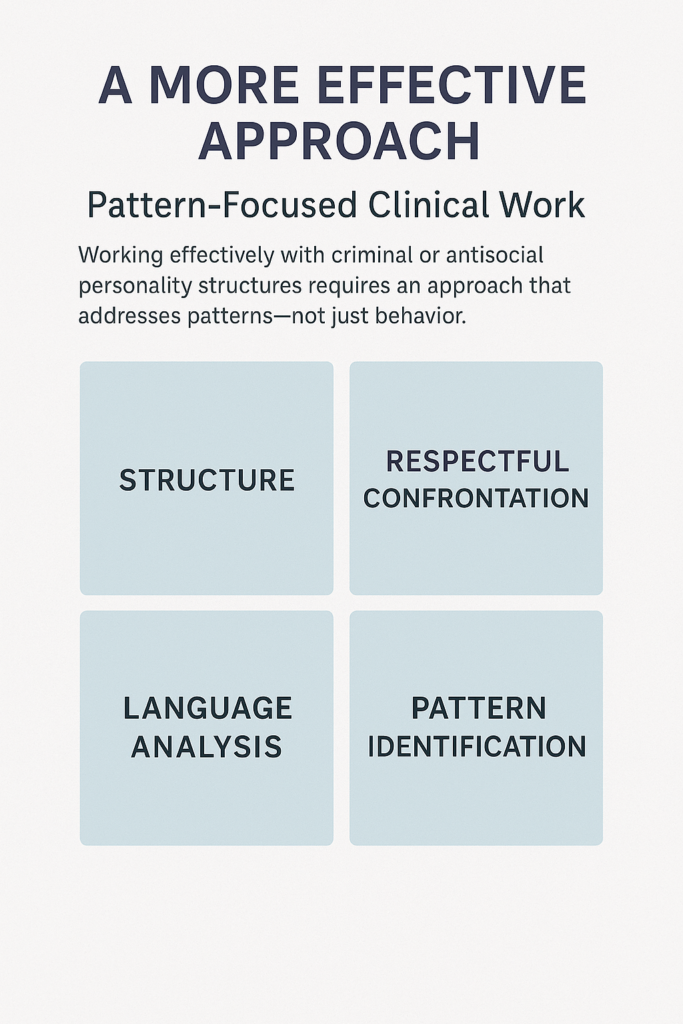
Working effectively with criminal or antisocial personality structures requires an approach that addresses patterns—not just behavior.
a). Structure
Sessions must have consistent direction and therapeutic boundaries.
The narrative is not client-driven; it is clinician-guided.
b). Respectful Confrontation
Not aggressive.
Not humiliating. But firmly rooted in:
- Evidence
- Inconsistencies
- Narrative patterns
- Themes of avoidance
The goal is to disrupt protective narratives without rupturing therapeutic alliance.
c). Language Analysis
This is where CLP (Clinical Language Profiling) shines.
Language reveals:
- Contradictions
- Themes
- Patterns of justification
- Omissions of emotion
- Distortions
- Narrative “fault lines”
CLP allows clinicians to detect change—or resistance—before it becomes visible behaviorally.
d). Pattern Identification
The therapist does not focus on isolated events.
The focus is on:
- Recurrence
- Narrative loops
- Emotional absences
- Self-protective storylines
- Justification systems
True change occurs when the underlying architecture of thought is reconstructed—not when isolated behaviors are corrected.
Conclusion
A strategic reduction of the severity of the behavior.
Examples:
- Narrative identity
- Cognitive distortions
- Emotional defenses
- Learned strategies of survival
Patterns are not random.
They are built, repeated, and reinforced until they become the person’s psychological reality.
To create meaningful change, therapy must address the story, not just the behavior.